
Error in FMC signal convergence using avrg with different numbers of elements per wavelength 回答済み

Hi,
I was investigating the signal convergence for a dataset recorded from FMC acquisition simulated using Onscale for the following numbers of elements per wavelength (5,10,15,20,25,30,35 and 40) and I have noticed that the higher the number of elements the smaller the signal amplitude. For instance, I have simulated the FMC acquisition example, available at https://support.onscale.com/hc/en-us/articles/360006838851-Full-Matrix-Capture-2D , for nelem from 5 to 40 by emitting on element 4 and receiving on all 8 elements.
The image below shows the received signals in element 3:

- Zooming in on the image we can notice tha the signal amplitude decreases as the number of elements per wavelength increases.

-
since my goal is to determine the best nelem for my simulation I have tested the signal convergence of the pressure for a single element by storing it as follows: hist xyz pres $pres_x $pres_x 1 $pres_y $pres_y 1. The image below shows the pressure for nelem ranging from 5 to 40.
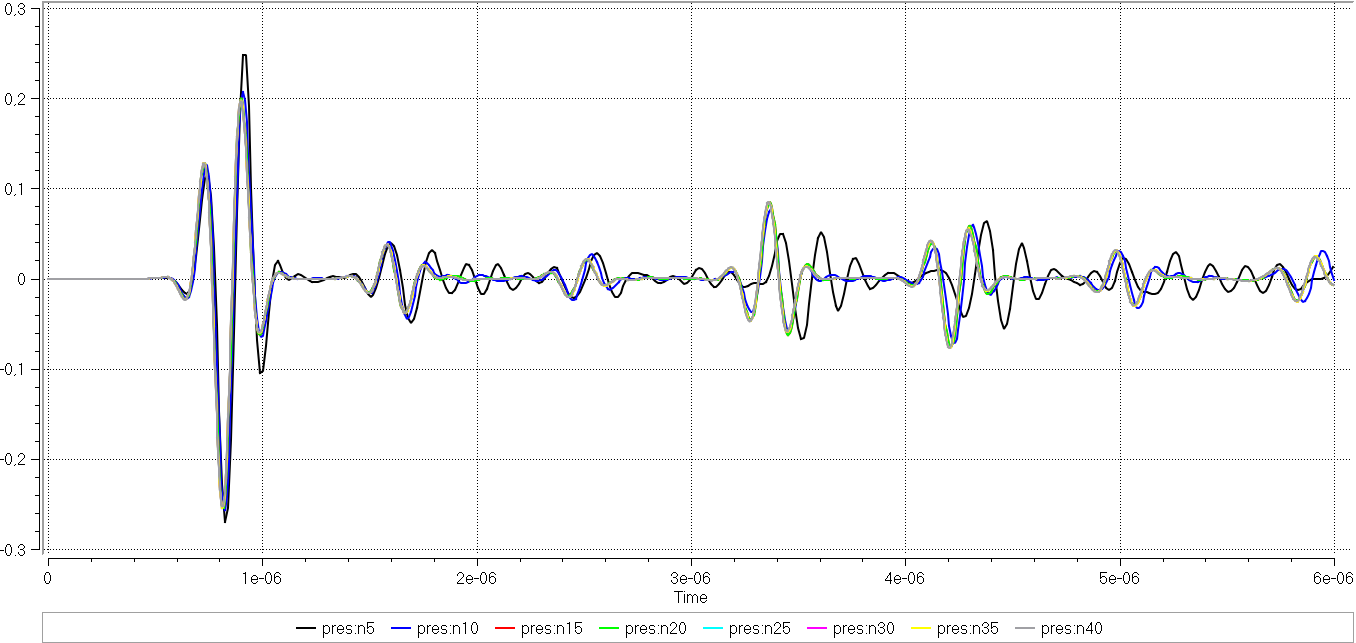
- zoom in on window 0-1.5µ. The signals seem to converge in amplitude from nelem = 15

Why the avrg function is affected by the numbers of elements per wavelength? And how can I solve this problem ?
Best regards,
Ray
3件のコメント
Hi Rayanne,
What a great question, you would not usually expect the amplitude of the signal to change if you are changing the mesh but if you look at what the model looks like at 5 elements per wavelength, you can see maybe why this happens.
The defect is very blocky using 5 elements per wavelengths, this is likely changing the path of the wave as it propagates past it causing differences in amplitude. I predict as the defect becomes more of a perfect circle with a finer mesh the results will converge to the same amplitude.
Best Regards,
Chloe.
Hi Chloe,
Thanks for your help. Now, I`m storing the pressure at a point located in the center of the element 3 (remeber that I was analysing the received signals in element 3) and with a difference of 0.2mm in height (y_elem3 = 10mm and y_pres = 9.8mm). If the shape of the defect is affecting the convergence, (as shown on avrg) I should be able to see it on this new test.
The pressure at a single point located in the center of the element 3 does not have a large amplitude difference as shown in the average pressure graph.
avrg:
pres:
Using the avrg function the signal amplitude is always decreasing while the same does not happen when I`m applying the pres function. By using the pres function the signal converges to the same amplitude from nelem = 30.
Being the problem the shape of the defect, why I can`t see the amplitude decreasing when using the pres function? When I`m changing the nelem, I`m also changing the box, It seems that the box is affecting the average computation.
Best Regards,
Ray
Hi Ray,
Sorry for the initial confusion. Calc avrg is affected by the number of elements per wavelength as it is taking the average over an area. For 5 epw the wavelength, the area is 3 times bigger than 15 epw therefore there is more wave in that area so the amplitude is higher.
In your comparison example you are just taking pressure at a point, rather than averaging over an area which is why the difference isn't as noticible.
Does this makes sense?
Best Regards,
Chloe.
サインインしてコメントを残してください。
お探しのものを見つけられませんでしたか?
新規投稿